
Learning how to use examples in content can transform your writing from boring to brilliant. When you know how to use examples in writing, your readers connect better with your message, understand complex ideas faster, and remember your content longer.
Think about the last time someone explained something complicated to you. Did they use examples? Most likely, yes. That’s because our brains are wired to understand new information when it’s connected to something familiar.
Examples of content in writing serve multiple purposes:
- They make abstract concepts concrete
- They help readers visualize your points
- They provide proof for your claims
- They keep readers engaged and interested
- They make your content more memorable
When you master how to use examples in content, you’re essentially building bridges between your ideas and your reader’s understanding.
The Science Behind Using Examples
Research shows that people remember stories and examples 22 times more than facts alone. This is why content-based example strategies work so well in communication.
When you use content in a sentence with examples, you activate different parts of the reader’s brain. The logical part processes the information, while the creative part visualizes the example. This dual processing makes your content stick.
Examples of how to use i.e. in sentences demonstrate this principle perfectly:
- “Many social media platforms (i.e., Facebook, Twitter, Instagram) use algorithms to show content.”
- “Content marketing tools (i.e., blogs, videos, podcasts) help businesses reach their audience.”
Types of Examples You Can Use
Understanding different types of examples helps you choose the right one for your content. Here are the main categories:
Real-Life Examples
These are actual situations or cases that happened. They’re powerful because they’re true and relatable.
Example of content in a sentence: “Netflix increased subscriber engagement by 80% when they started using personalized content recommendations.”
Hypothetical Examples
These are made-up scenarios that could realistically happen. They help readers imagine themselves in similar situations.
Analogies and Metaphors
These compare unfamiliar concepts to familiar ones. They’re excellent for explaining complex topics.
Statistics and Data
Numbers tell stories too. When you present data as examples, they become more meaningful.
Personal Stories
Sharing your own experiences makes your content authentic and builds trust with readers.
How to Use Examples in a Sentence
Knowing how to use examples in a sentence properly is crucial for clear communication. Here are several effective methods:
Using “For Example” or “For Instance”
How to use example in a sentence with these phrases:
- “Content marketing takes many forms. For example, blog posts, videos, and social media updates all count as content marketing.”
- “Many companies struggle with content creation. For instance, small businesses often lack the time to write regular blog posts.
Using Parentheses
How to use in example in a sentence with parentheses:
- “Social media platforms (like Instagram and TikTok) prioritize video content.”
- “Content management systems (such as WordPress and Drupal) make publishing easier.”
Using Colons
Examples of how to use a colon in a sentence for introducing examples:
- “Three types of content perform best on social media: videos, images, and interactive posts.”
- “Content creators need several tools: writing software, image editors, and scheduling platforms.”
Content-Based Example Strategies
A content-based example approach means your examples directly relate to your topic and audience. This strategy ensures relevance and maintains reader interest.
Match Examples to Your Audience
If you’re writing for beginners, use simple, everyday examples. For experts, you can use more sophisticated industry-specific cases.
Use Progressive Examples
Start with basic examples and gradually introduce more complex ones. This helps readers build understanding step by step.
Include Negative Examples
Sometimes showing what NOT to do is as valuable as showing what TO do. Negative examples help readers avoid common mistakes.
Examples of Content in Writing
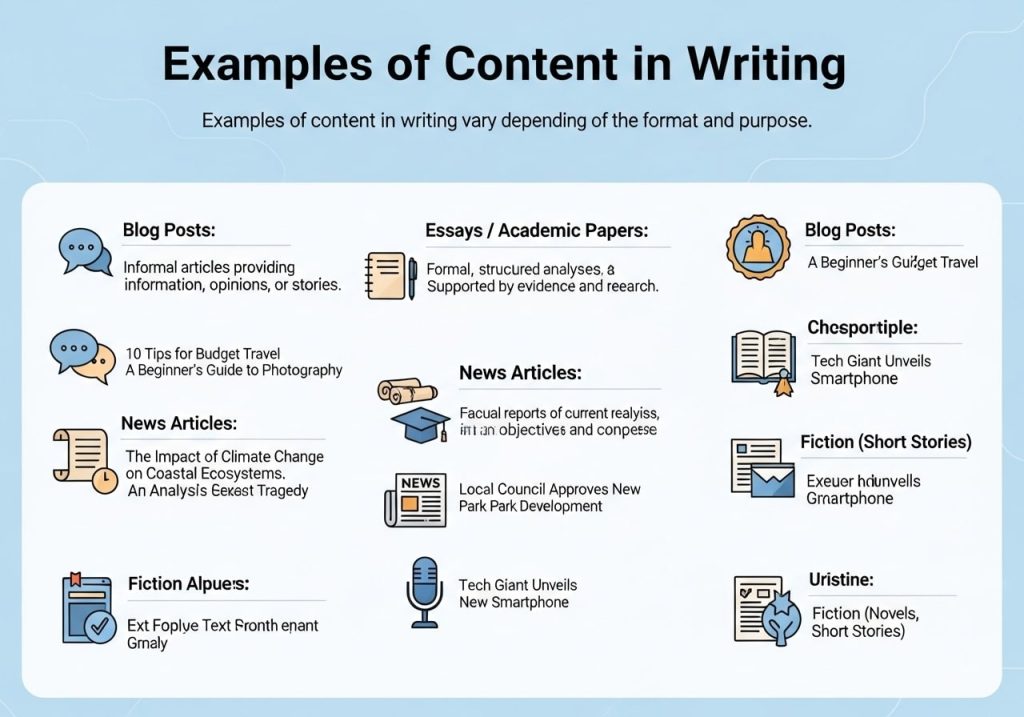
Examples of content in writing vary depending on the format and purpose. Here’s how different types of writing use examples:
Blog Posts
Blog posts often use:
- Case studies to prove points
- Personal anecdotes to build connection
- Step-by-step examples to explain processes
- Screenshots or images to show rather than tell
Marketing Copy
Marketing content uses:
- Customer testimonials as social proof
- Before and after scenarios
- Success stories and results
- Product demonstrations
Educational Content
Educational writing includes:
- Practice problems with solutions
- Real-world applications of concepts
- Historical examples and case studies
- Visual examples like charts and diagrams
Technical Writing
Technical content features:
- Code snippets and programming examples
- Troubleshooting scenarios
- Configuration examples
- API usage examples
Examples of Content in Education
Examples of content in education serve special purposes in learning environments. They help students connect theory to practice and understand abstract concepts through concrete instances.
Classroom Applications
Teachers use examples to:
- Explain new concepts using familiar references
- Show practical applications of theoretical knowledge
- Help students remember information through stories
- Encourage critical thinking through case analysis
Online Learning
Digital education platforms use:
- Interactive examples students can manipulate
- Video examples showing processes in action
- Simulation examples for safe practice
- Peer examples from other students
Training Materials
Corporate training uses:
- Role-playing scenarios
- Workplace situation examples
- Best practice case studies
- Problem-solving examples
3 Ways to Find Content You Can Use
When you need to explain 3 ways to find content you can use, here are proven methods:
Method 1: Industry Research
Look at your industry leaders and competitors. See what types of examples they use and how they present them. Don’t copy, but learn from their approach.
- Read industry publications and blogs
- Follow thought leaders on social media
- Attend conferences and webinars
- Join professional forums and communities
Method 2: Customer Feedback and Data
Your customers are a goldmine of example material. Their questions, complaints, and success stories become powerful examples.
- Review customer service tickets
- Analyze user behavior data
- Conduct surveys and interviews
- Monitor social media mentions
Method 3: Personal Experience and Observation
Draw from your own experiences and the world around you. The best examples often come from everyday situations.
- Keep a journal of interesting observations
- Document your own learning experiences
- Note problems and solutions you encounter
- Collect stories from colleagues and friends
Common Mistakes When Using Examples
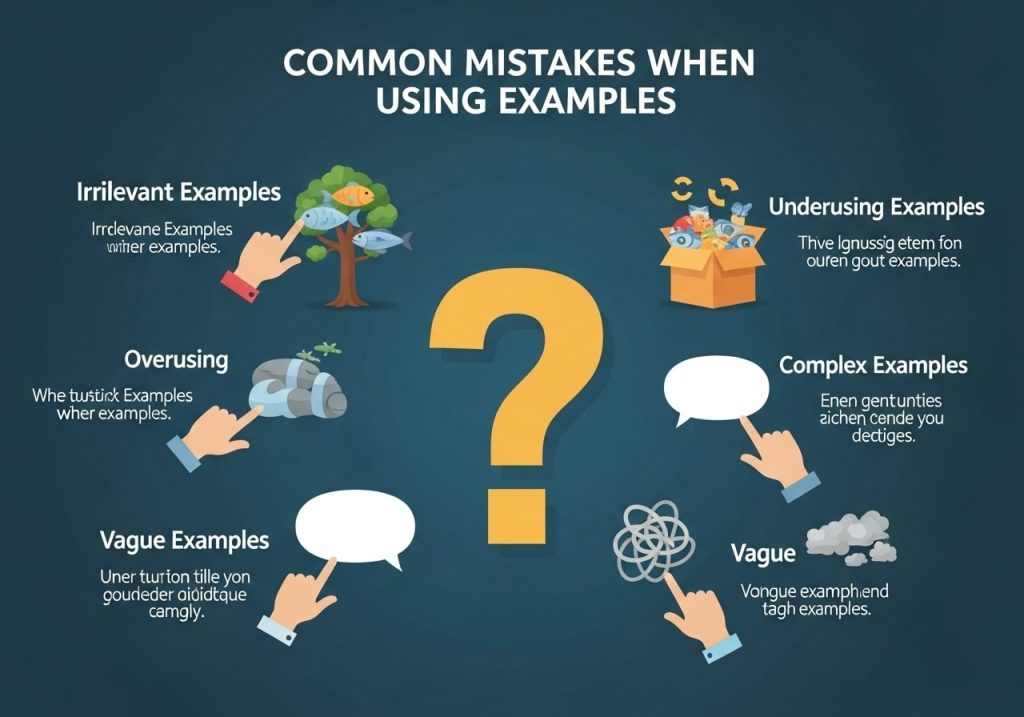
Even when you know how to use examples in content, certain mistakes can reduce their effectiveness:
Using Irrelevant Examples
Examples that don’t directly relate to your point confuse rather than clarify. Always ensure your examples support your main message.
Overusing Examples
Too many examples can overwhelm readers and dilute your message. Use just enough to make your point clear.
Using Outdated Examples
Old examples, especially in fast-changing industries, can make your content seem stale and unreliable.
Focusing Only on Success Stories
While positive examples are great, including failures and challenges makes your content more realistic and helpful.
Making Examples Too Complex
If your example is harder to understand than your original point, it’s not serving its purpose.
Best Practices for Example Usage
Keep Examples Relevant and Current
Use recent examples that your audience can relate to. Update your examples regularly to keep your content fresh.
Use a Mix of Example Types
Combine different types of examples to appeal to different learning styles and keep your content interesting.
Make Examples Specific
Vague examples don’t help readers understand. Use specific details, numbers, and concrete descriptions.
Test Your Examples
Ask others if your examples make sense. What’s clear to you might not be clear to your readers.
Provide Context
Don’t assume readers understand the background of your examples. Give enough context for them to make sense.
Advanced Techniques for Using Examples
The Sandwich Method
Place your main point between two examples: start with an example to grab attention, explain your point, then use another example to reinforce it.
The Build-Up Technique
Use a series of small examples that build toward a bigger point. This creates momentum and keeps readers engaged.
The Contrast Method
Show two opposing examples to highlight differences and make your point clearer.
Using Content Words in Sentences
When you understand what are content words in a sentence, you can make your examples more powerful. Content words (nouns, verbs, adjectives, adverbs) carry the main meaning, while function words (articles, prepositions, conjunctions) provide structure.
Focus on strong content words in your examples:
- Instead of: “The company did well”
- Use: “Netflix increased subscribers by 25%”
Measuring the Impact of Your Examples
Track how well your examples work:
- Monitor engagement metrics on content with examples
- Ask readers which parts they found most helpful
- Test different example types to see what resonates
- Use A/B testing for different example approaches
Creating a Personal Example Library
Start building your own collection of examples:
- Organize by Topic: Sort examples by subject matter
- Update Regularly: Add new examples and remove outdated ones
- Note the Source: Remember where examples came from for credibility
- Test Effectiveness: Track which examples work best
Conclusion
Learning how to use examples in content is one of the most valuable skills for any writer. Examples bridge the gap between complex ideas and reader understanding. They make your content more engaging, memorable, and useful.
Remember that good examples don’t just illustrate points—they make your content come alive. Whether you’re writing blog posts, creating educational materials, or developing marketing content, examples help your readers connect with your message on a deeper level.
Start implementing these strategies today. Begin with simple examples and gradually experiment with more sophisticated techniques. Pay attention to what works for your audience and refine your approach over time.
What examples will you use in your next piece of content? Share your thoughts and experiences in the comments below. Your example might be exactly what another reader needs to understand this concept better.
Ready to improve your content with better examples? Download our free example template library and start creating more engaging content today.
FAQs
What makes examples so important in writing?
Examples help readers understand complex ideas by connecting them to familiar situations. They turn abstract concepts into concrete scenarios that people can relate to, making your content easier to follow and remember.
What types of examples work best in content writing?
The most effective examples are real-life scenarios, case studies, personal stories, and simple analogies. Choose examples that your readers can easily understand and connect with their own experiences.
How many examples should I include in my content?
Use examples strategically rather than overwhelming your readers. Include one strong example for each main point you’re making. For longer content, aim for 2-3 examples per section to maintain balance between explanation and illustration.
Where should I place examples in my writing?
Place examples right after introducing a new concept or making a key point. This immediate reinforcement helps readers grasp the idea before moving on. You can also use examples at the beginning of sections to grab attention.
How do I choose relevant examples for my audience?
Consider your readers’ background, interests, and experience level. Use examples from industries, situations, or contexts they know well. Avoid examples that require specialized knowledge your audience might not have.
Can I use personal stories as examples in professional content?
Yes, personal stories can be very effective when they’re relevant and appropriate. They add authenticity and help build connection with readers. Keep them brief and directly tied to your main point.
How do I make sure my examples don’t confuse readers?
Keep examples simple and directly related to your point. Avoid complex scenarios with too many details. If your example needs explanation, it’s probably too complicated. Test your examples by asking if they make the concept clearer or more confusing.
Should I use hypothetical examples or real ones?
Both work well depending on your purpose. Real examples add credibility and proof, while hypothetical ones let you create perfect illustrations of your points. Mix both types, but always label hypothetical examples clearly.
How can I make my examples more engaging?
Use specific details, include emotions or outcomes, and choose examples with interesting elements. Paint a clear picture that helps readers visualize the situation. Stories with challenges and solutions tend to hold attention well.
What should I avoid when using examples in my content?
Avoid examples that are too complex, outdated, culturally insensitive, or unrelated to your main point. Don’t use so many examples that they overshadow your actual message. Also avoid examples that might alienate parts of your audience.