Writing effective SEO-friendly product descriptions can make the difference between a product that sits unseen in search results and one that drives consistent sales. When you learn how to write SEO-friendly product descriptions, you’re not just creating content – you’re building bridges between potential customers and your products.
What Are SEO-Friendly Product Descriptions?
SEO-friendly product descriptions are carefully crafted product descriptions that help your products show up higher in search engine results while also convincing visitors to make a purchase. These descriptions serve two masters: search engines and human customers.
Unlike regular product descriptions that might only focus on features, SEO product descriptions are optimized with specific keywords, structured for easy reading, and written to match what your customers are actually searching for online.
Think of them as your product’s elevator pitch to both Google and your potential customers. They need to be informative enough for search engines to understand what you’re selling, while being persuasive enough to turn browsers into buyers.
Key Components of SEO Product Descriptions
Every effective SEO friendly product description includes:
- Target keywords are naturally woven throughout the text
- Clear product benefits that address customer pain points
- Technical specifications when relevant
- Emotional triggers that motivate purchases
- Proper formatting with headers, bullet points, and short paragraphs
Why SEO Product Descriptions Matter for Your Business
When you invest time in creating SEO-friendly product descriptions, you’re investing in long-term organic traffic. Here’s why they’re so important:
Increased Search Visibility
Products with well-optimized descriptions appear higher in search results. When someone searches for “wireless bluetooth headphones,” your product has a better chance of appearing on the first page if your product description SEO is on point.
Better User Experience
SEO friendly product pages don’t just rank well – they provide visitors with the information they need to make confident purchasing decisions. This leads to lower bounce rates and higher conversion rates.
Reduced Marketing Costs
Once your SEO product descriptions start ranking well, they bring in free organic traffic month after month. This reduces your dependence on paid advertising and improves your profit margins.
Competitive Advantage
Many businesses still use basic, keyword-light product descriptions. When you master how to write product descriptions for SEO, you automatically stand out from competitors who haven’t optimized their content.
Essential Elements of SEO-Friendly Product Descriptions
Creating effective SEO-friendly product descriptions requires attention to several key elements. Each component plays a specific role in helping your products rank better and convert more visitors into customers.
Primary and Secondary Keywords
Your keywords for product description should include one primary keyword and several related terms. For example, if you’re selling running shoes, your primary keyword might be “men’s running shoes,” while secondary keywords could include “athletic footwear,” “jogging shoes,” and “sport shoes.”
Research shows that long-tail keywords for product pages often convert better than broad terms. Instead of targeting “shoes,” try “comfortable running shoes for flat feet” or “waterproof hiking boots for women.”
Compelling Headlines and Subheadings
Structure your SEO friendly description with clear headings that include your target keywords. This helps search engines understand your content structure and makes it easier for customers to scan for relevant information.
Use H2 and H3 tags for subheadings like:
- Key Features and Benefits
- Technical Specifications
- Size and Fit Guide
- Customer Reviews Highlights
Benefit-Focused Content
While features tell customers what your product has, benefits explain what your product does for them. Transform technical features into customer benefits:
- Instead of: “Made with moisture-wicking polyester fabric”
- Write: “Keeps you dry and comfortable during intense workouts”
Social Proof and Trust Signals
Include elements that build confidence in your SEO product description:
- Customer review snippets
- Awards or certifications
- Money-back guarantees
- Shipping information
- Return policies
How to Write SEO-Friendly Product Descriptions: Step-by-Step Guide
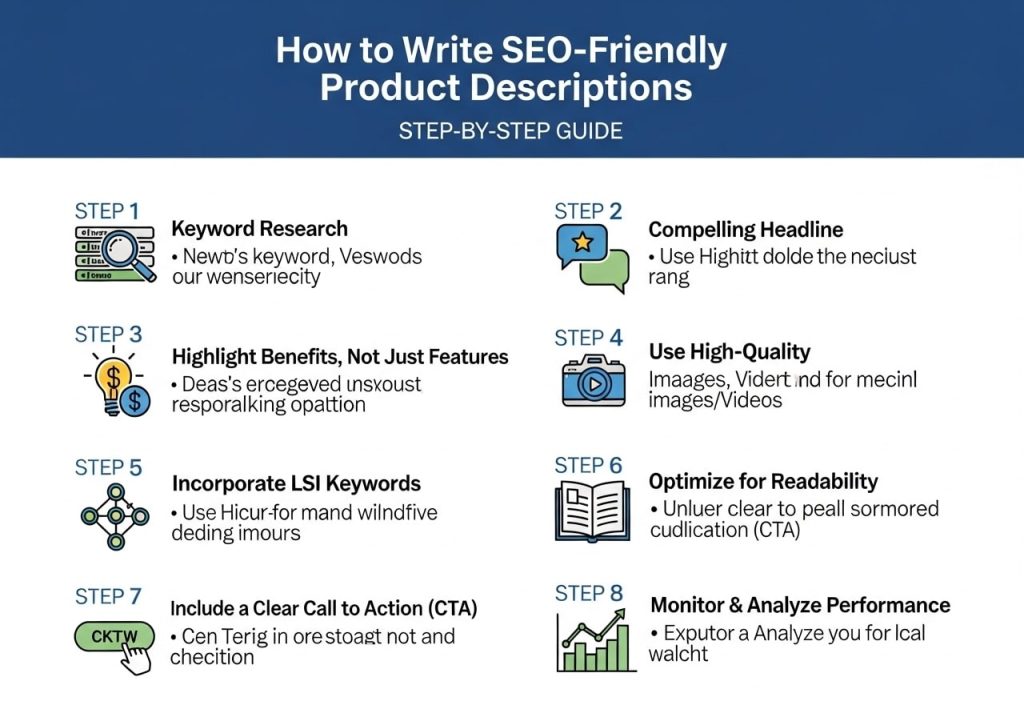
Learning how to write SEO-friendly product descriptions becomes easier when you follow a systematic approach. Here’s your step-by-step roadmap to creating descriptions that both rank and sell.
Step 1: Research Your Target Keywords
Before writing a single word, research how to choose keywords for product pages. Use tools like:
- Google Keyword Planner for search volume data
- Ubersuggest for keyword suggestions and competitor analysis
- Answer The Public for question-based keywords
- Google Search Console to see which terms already bring traffic
Focus on finding keywords with decent search volume but manageable competition. Long-tail keywords for product pages often provide the best opportunities for smaller businesses.
Step 2: Analyze Your Competition
Look at the top-ranking products for your target keywords. What do their SEO product descriptions include? How long are they? What features do they emphasize?
Don’t copy competitors, but identify gaps in their content that you can fill with more comprehensive or better-organized information.
Step 3: Create a Description Outline
Plan your SEO friendly product description structure:
- Opening paragraph with primary keyword and main benefit
- Key features section with bullet points
- Detailed benefits explanation
- Technical specifications (if applicable)
- Usage instructions or suggestions
- Trust signals and guarantees
Step 4: Write Your First Draft
Start writing your product description SEO content, keeping these guidelines in mind:
- Lead with benefits in your opening paragraph
- Use your primary keyword in the first 100 words
- Include secondary keywords naturally throughout
- Write for humans first, search engines second
- Keep sentences short and paragraphs under 3-4 lines
Step 5: Optimize and Refine
Review your draft for SEO for product description best practices:
- Keyword density should feel natural (aim for 1-2% for primary keywords)
- Include semantic keywords (related terms Google associates with your main keyword)
- Add internal links to related products or categories
- Format for readability with bullet points, bold text, and white space
Step 6: Test and Measure
After publishing your SEO-friendly product descriptions, monitor their performance:
- Track search rankings for target keywords
- Monitor organic traffic to product pages
- Measure conversion rates and bounce rates
- A/B test different versions when possible
SEO Product Description Examples That Actually Work
Let’s examine some SEO product description examples to see these principles in action. These examples show how to balance optimization with persuasive copywriting.
Example 1: Wireless Bluetooth Headphones
Title: Premium Wireless Bluetooth Headphones with Noise Cancellation – 30 Hour Battery Life
Description:
Experience crystal-clear audio with our premium wireless Bluetooth headphones, designed for music lovers who demand exceptional sound quality and all-day comfort.
Key Benefits:
- 30-hour battery life keeps your music playing all day and night
- Active noise cancellation blocks out distractions for immersive listening
- Quick charge technology provides 5 hours of playback in just 10 minutes
- Comfortable over-ear design with memory foam padding for extended wear
These Bluetooth headphones feature advanced audio drivers that deliver rich bass, clear mids, and crisp highs across all music genres. Whether you’re commuting, working out, or relaxing at home, the ergonomic design ensures comfort during extended listening sessions.
Technical Specifications:
- Bluetooth 5.0 connectivity with 33-foot range
- 40mm dynamic drivers
- USB-C charging with included cable
- Compatible with iOS, Android, and Windows devices
30-day money-back guarantee and 2-year warranty included with every purchase.
Example 2: Organic Coffee Beans
Title: Premium Organic Coffee Beans – Single Origin Ethiopian Arabica – Freshly Roasted
Description:
Discover the rich, complex flavors of our single-origin Ethiopian Arabica coffee beans, ethically sourced and freshly roasted in small batches for maximum freshness and flavor.
What Makes Our Organic Coffee Special:
- Certified organic beans grown without pesticides or chemicals
- Single-origin Ethiopian Arabica from high-altitude farms
- Small batch roasting ensures optimal flavor development
- Medium roast profile brings out natural chocolate and citrus notes
Each bag contains carefully selected coffee beans from Ethiopian farms committed to sustainable growing practices. Our master roaster develops each batch to highlight the unique terroir and natural flavor characteristics.
Tasting Notes:
- Aroma: Floral with hints of bergamot
- Flavor: Chocolate undertones with bright citrus finish
- Body: Medium with smooth mouthfeel
- Acidity: Bright and clean
Free shipping on orders over $25 and satisfaction guaranteed or your money back.
Keywords for Product Pages: Research and Implementation

Understanding how to choose keywords for product pages is fundamental to creating SEO-friendly product descriptions that actually drive traffic and sales. Your keyword strategy determines whether potential customers can find your products when they’re ready to buy.
Types of Keywords for Product Descriptions
- Primary Keywords are your main target terms that directly describe your product. For a leather jacket, this might be “men’s leather jacket” or “genuine leather motorcycle jacket.”
- Secondary Keywords support your primary terms and include variations like “leather coat,” “biker jacket,” or “black leather outerwear.”
- Long-tail Keywords are longer, more specific phrases that often indicate buying intent: “waterproof leather motorcycle jacket with armor” or “vintage brown leather jacket for men.”
- Semantic Keywords are terms Google associates with your main keywords. For leather jackets, these might include “genuine,” “cowhide,” “full-grain,” or “lambskin.”
Keyword Research Process
Start your research by brainstorming terms your customers might use to find your products. Think about:
- Different names for your product (sofa vs. couch vs. sectional)
- Material variations (leather, fabric, microfiber)
- Size options (queen size, king size, California king)
- Color choices (navy blue, midnight blue, dark blue)
- Use cases (office chair, gaming chair, desk chair)
Use Google’s autocomplete feature by typing your main keyword and seeing what suggestions appear. These are actual searches people perform, making them valuable keywords for product description optimization.
Check Google’s “People also ask” section for question-based keywords you can address in your descriptions. Questions like “How to clean leather jackets” or “What size leather jacket should I buy” can inspire helpful content sections.
Keyword Implementation Best Practices
Once you’ve identified your target keywords for product pages, implement them strategically throughout your SEO product descriptions:
- Product title: Include your primary keyword naturally in the product name
- opening paragraph: Use your main keyword within the first 100 words
- Subheadings: Incorporate secondary keywords in H2 and H3 tags
- Throughout the description: Sprinkle related terms naturally in the body text
- meta descriptions: Include primary keywords in your product page meta description
Avoid keyword stuffing, which makes content sound unnatural and can hurt your rankings. Focus on creating helpful, readable content that naturally incorporates your target terms.
SEO-Friendly Product Descriptions for Shopify
SEO-friendly product descriptions Shopify stores require special attention to the platform’s unique features and limitations. Shopify provides several tools and fields specifically designed to help optimize your product description SEO.
Shopify-Specific SEO Features
Product Title Field: This becomes your H1 tag and should include your primary keyword. Keep titles under 60 characters to prevent truncation in search results.
Meta Description Field: Shopify automatically generates meta descriptions from your product description, but you can customize them. Write compelling 150-160 character summaries that include your main keyword.
URL Handle: Customize your product URLs to include relevant keywords. Instead of “/products/product-123”, use “/products/mens-leather-motorcycle-jacket”.
Alt Text for Images: Add descriptive alt text to all product images, incorporating relevant keywords naturally.
Optimizing Shopify Product Descriptions
When writing SEO friendly product descriptions for Shopify, structure your content using HTML formatting:
<h2>Key Features</h2>

<ul>

<li><strong>Premium Materials:</strong> Genuine full-grain leather</li>

<li><strong>Perfect Fit:</strong> Available in sizes S-XXL</li>

<li><strong>Weather Protection:</strong> Water-resistant coating</li>

</ul>
Use Shopify’s rich text editor to add formatting like bullet points, bold text, and headers. This improves readability and helps search engines understand your content structure.
Shopify Apps for SEO Product Descriptions
Several Shopify apps can help streamline your product description SEO efforts:
- TinyIMG helps optimize images and alt text automatically
- SearchPie provides SEO analysis and recommendationsPlug in SEO identifies SEO issues across your store
- Smart SEO automates meta tags and structured data
Product Variants and SEO
For products with multiple variants (sizes, colors, materials), create unique content for each significant variation. Don’t just change one word – explain how different colors or materials affect the product’s benefits or use cases.
SEO product variations should each target slightly different keywords. A red leather jacket might target “red leather jacket for women” while the black version targets “black leather motorcycle jacket.”
Common Mistakes to Avoid

Even well-intentioned business owners make mistakes when creating SEO-friendly product descriptions. Avoiding these common pitfalls can significantly improve your search rankings and conversion rates.
Mistake #1: Using Manufacturer Descriptions
Copying manufacturer descriptions creates duplicate content issues and provides no competitive advantage. Every retailer selling the same product would have identical descriptions, making it impossible to stand out.
Instead, write original SEO product descriptions that highlight unique benefits, use cases, or positioning specific to your brand and customers.
Mistake #2: Focusing Only on Features
Technical specifications matter, but customers buy benefits, not features. Transform every feature into a customer benefit:
- Feature: “Made with moisture-wicking fabric”
- Benefit: “Keeps you cool and dry during intense workouts”
Mistake #3: Ignoring Search Intent
Understanding why people search for specific keywords for product description helps you create more relevant content. Someone searching “best running shoes for beginners” has different needs than someone searching “professional marathon running shoes.”
Match your product description SEO content to the searcher’s intent and experience level.
Mistake #4: Overoptimizing for Keywords
Keyword stuffing makes content sound robotic and can actually hurt your search rankings. Focus on creating natural, helpful content that incorporates keywords where they make sense.
If you’re struggling to fit keywords naturally, it usually means you need more content, not more keywords crammed into existing sentences.
Mistake #5: Neglecting Mobile Users
Many customers shop on mobile devices, where long blocks of text become difficult to read. Format your SEO friendly product descriptions with:
- Short paragraphs (2-3 sentences maximum)
- Bullet points for easy scanning
- Plenty of white space
- Bold text to highlight important information
Mistake #6: Writing Generic Descriptions
Generic descriptions that could apply to dozens of similar products don’t help customers or search engines understand what makes your product special. Include specific details about:
- Exact materials and construction methods
- Precise dimensions and specifications
- Unique features or design elements
- Specific use cases or applications
Advanced Tips for Product Description SEO
Once you’ve mastered the basics of how to write SEO-friendly product descriptions, these advanced strategies can help you outperform competitors and drive even better results.
Schema Markup for Products
Implement Product Schema markup to help search engines understand your product information better. This can lead to rich snippets in search results, showing prices, availability, and review ratings directly in search listings.
Key schema properties for SEO product descriptions include:
- Product name and description
- Price and currency
- Availability status
- Brand information
- Review ratings and count
- Product images
User-Generated Content Integration
Incorporate customer reviews and questions into your product description SEO strategy. User-generated content provides fresh, keyword-rich content that search engines love.
Create sections like:
- Customer Favorites: Highlight popular features mentioned in reviews
- Frequently Asked Questions: Address common customer concerns
- Styling Tips: Show how customers use your products
Seasonal and Trending Keywords
Update your keywords for product pages based on seasonal trends and current events. A winter coat might target “warm winter jacket” during cold months but “lightweight spring jacket” during transitional weather.
Use Google Trends to identify when specific keywords peak in search volume and adjust your SEO friendly product descriptions accordingly.
Internal Linking Strategy
Create a strong internal linking structure between related products and categories. This helps search engines understand your site structure and keeps customers engaged longer.
Link strategies for product category SEO:
- Link to complementary products (“Perfect with…”)
- Connect to related categories (“Shop more…”)
- Reference buying guides or comparison pages
- Connect to brand or collection pages
International SEO Considerations
If you sell internationally, adapt your SEO product descriptions for different markets:
- Translate keywords, don’t just translate content
- Research local search terms and preferences
- Adjust for cultural differences in product use
- Consider local sizing standards and measurements
Tools and Resources
The right tools can significantly streamline your product description SEO efforts and help you create better-optimized content faster.
Keyword Research Tools
Free Options:
- Google Keyword Planner: Basic search volume and keyword suggestions
- Ubersuggest: Limited free searches with keyword ideas and competition data
- Answer The Public: Question-based keyword research
- Google Trends: Seasonal and trending keyword data
Paid Options:
- SEMrush: Comprehensive keyword research with competitor analysis
- Ahrefs: Advanced keyword tools with difficulty scores
- Moz Pro: Keyword research with SERP analysis
- KWFinder: User-friendly interface with accurate difficulty metrics
Content Optimization Tools
- Surfer SEO analyzes top-ranking pages to suggest optimal keyword usage and content length for your SEO-friendly product descriptions.
- Clearscope provides real-time content optimization suggestions as you write, helping ensure your product description SEO meets search engine expectations.
- MarketMuse uses AI to identify content gaps and suggest related topics to include in your descriptions.
SEO Friendly Description Generators
While SEO friendly description generators can provide inspiration, avoid relying on them entirely. Use them as starting points, then customize the output with:
- Your unique brand voice
- Specific product details
- Customer-focused benefits
- Targeted keywords for your market
Popular generators include:
- Copy.ai for general product descriptions
- Jasper for longer-form content
- Writesonic for quick product copy
- INK Editor with built-in SEO optimization
Remember, the best SEO product descriptions combine tool insights with human creativity and market knowledge.
Creating effective SEO-friendly product descriptions requires balancing search engine optimization with compelling copywriting that drives sales. By following the strategies outlined in this guide, you’ll be able to write descriptions that not only rank higher in search results but also convert more visitors into customers.
Remember that product description SEO is an ongoing process. Monitor your results, test different approaches, and continuously refine your descriptions based on performance data and customer feedback. The time you invest in mastering how to write SEO-friendly product descriptions will pay dividends through increased organic traffic and higher conversion rates.
Ready to transform your product descriptions? Start with your best-selling products, apply these SEO product description strategies, and watch your search rankings and sales improve over the coming months.
FAQs
What makes a product description SEO friendly?
An SEO friendly product description includes relevant keywords that people actually search for, has a clear title, and provides useful information about the product. You want to write naturally while including terms customers might type into Google when looking for your product.
How long should my product descriptions be for good SEO?
Most effective product descriptions are between 150-300 words. This gives you enough space to include important keywords and details without making the text too long. Focus on quality information rather than just hitting a word count.
Where should I place keywords in my product descriptions?
Put your main keyword in the product title, the first paragraph, and naturally throughout the description. Don’t stuff keywords everywhere – Google prefers descriptions that read naturally and provide real value to customers.
Should I use the same description across multiple websites?
No, avoid copying the same description to different sites. Google sees this as duplicate content and may lower your rankings. Write unique descriptions for each platform, even if you’re selling the same product.
What’s the difference between writing for SEO and writing to sell?
You don’t have to choose one over the other. Good product descriptions do both by using keywords customers search for while highlighting benefits that make them want to buy. Think about what questions customers have and answer them clearly.
How do I find the right keywords for my product descriptions?
Start by thinking like your customer. What words would they use to search for your product? You can also check what competitors use, look at customer reviews for common phrases, or use free tools like Google’s search suggestions.
Can I use bullet points in SEO product descriptions?
Yes, bullet points work great for SEO and readability. They help break up text, make key features easy to scan, and often include important keywords naturally. Just make sure each bullet point adds real value.
How often should I update my product descriptions?
Review your descriptions every few months or when you get new customer feedback. If you notice certain products aren’t ranking well or converting, that’s a good time to refresh the content with new keywords or better information.
Do product images affect SEO for descriptions?
While images don’t directly change how your description ranks, they work together with your text to create a better user experience. Use descriptive file names and alt text for images to support your overall SEO efforts.
What mistakes should I avoid when writing SEO product descriptions?
Don’t copy manufacturer descriptions, stuff too many keywords, write only technical specs, or forget about your actual customers. Also avoid making descriptions too short or generic – they won’t help with SEO or sales.