
Google loves detailed, helpful content that answers users’ questions completely. If you want to improve your search rankings, long form content SEO is one of the most effective strategies you can use. Studies show that long form content examples consistently outrank shorter pieces in search results.
What is Long Form Content for SEO?
Long form content SEO refers to creating detailed, comprehensive articles that thoroughly cover a topic while being optimized for search engines. These pieces typically provide more value to readers by going deep into subjects rather than just scratching the surface.
Search engines like Google prefer content that fully answers user queries. When someone searches for information, they want complete answers, not partial explanations. This is why long form articles tend to perform better in search rankings.
Benefits of Long Form Content for SEO
- Better search rankings: Longer content often ranks higher because it covers topics more completely
- Increased time on page: Readers spend more time engaging with detailed content
- More internal linking opportunities: Longer pieces allow for better site structure
- Higher social shares: People are more likely to share valuable, comprehensive content
- Improved authority: Detailed content establishes you as an expert in your field
What Qualifies as Long Form Content?
The definition of what qualifies as long form content varies depending on the medium and industry. Here’s a breakdown:
Written Content
- Blog posts: 1,500+ words
- Articles: 2,000+ words
- Guides: 3,000+ words
- Whitepapers: 5,000+ words
Video Content
- Long form videos: 10+ minutes
- YouTube long form content: 15+ minutes
- Educational videos: 20+ minutes
- Webinars: 30+ minutes
Social Media
- LinkedIn articles: 1,000+ words
- Facebook posts: 200+ words
- Twitter threads: 10+ tweets
The key isn’t just length – it’s about providing comprehensive value that couldn’t be delivered in a shorter format.
Long Form vs Short Form Content: Which is Better for SEO?
The long form vs short form content debate is common among content creators. Both have their place in a well-rounded content strategy, but they serve different purposes.
Long Form Content Advantages
- Better for complex topics that need detailed explanation
- Higher search engine rankings for competitive keywords
- More opportunities for keyword integration
- Better for establishing expertise and authority
- Higher conversion rates for bottom-of-funnel content
Short Form Content Advantages
- Easier to consume quickly
- Better for social media engagement
- Faster to produce
- Good for simple questions or announcements
- Works well for top-of-funnel awareness
When to Choose Each Format
Choose long form content when:
- Explaining complex processes or concepts
- Targeting competitive keywords
- Creating pillar content for your site
- Building topical authority
- Converting leads into customers
Choose short form content when:
- Sharing quick tips or updates
- Creating social media posts
- Answering simple questions
- Making announcements
- Creating content for busy audiences
Long Form Content Examples That Work
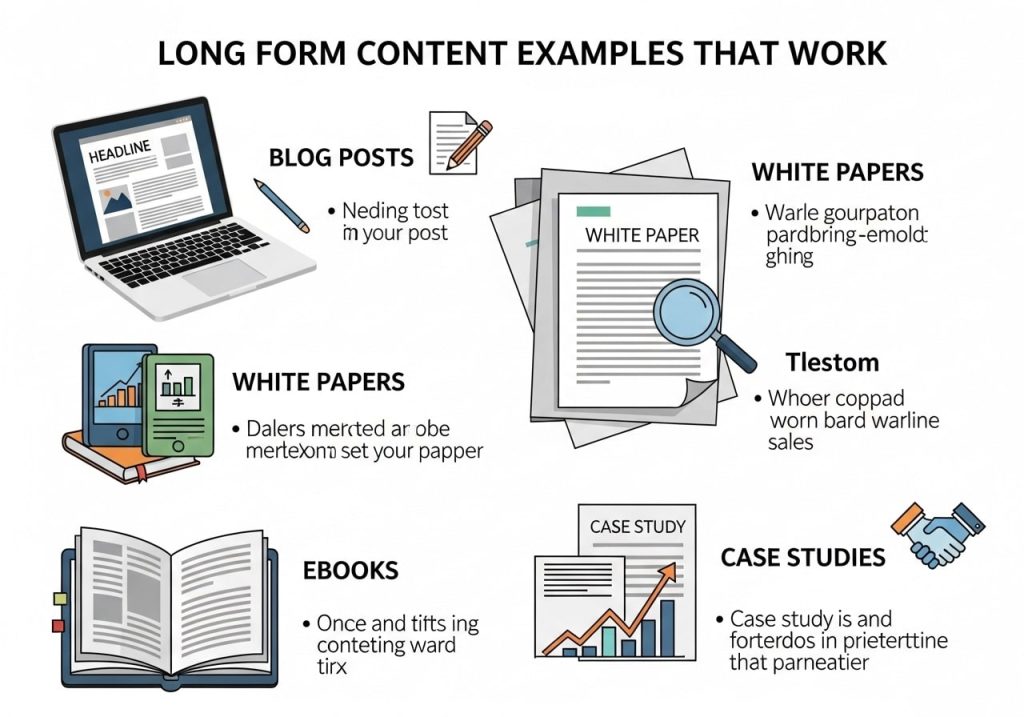
Looking at best long form articles can help you understand what makes content successful. Here are some long form content examples that consistently perform well:
Educational Guides
Companies like HubSpot and Moz create comprehensive guides that cover entire topics from start to finish. These seo long-form articles often rank for hundreds of related keywords.
Case Studies
Detailed case studies that show real results and walk through entire processes perform exceptionally well. They provide concrete examples and actionable insights.
Industry Reports
Annual reports with data, analysis, and predictions become go-to resources that attract links and social shares year after year.
How-To Tutorials
Step-by-step tutorials that leave nothing out become valuable resources that people bookmark and return to repeatedly.
Product Comparisons
Detailed comparisons that cover features, pricing, pros, and cons help users make informed decisions and often rank for buying-intent keywords.
Long Form Content SEO Template
Creating a long form content SEO template helps ensure consistency and completeness across your content. Here’s a proven template structure:
Introduction (200-300 words)
- Hook the reader with a compelling opening
- Clearly state what the article will cover
- Include your primary keyword naturally
- Promise specific value or outcomes
Main Body Sections
Each section should be 400-800 words and include:
- Clear headings with keywords where natural
- Subheadings to break up long sections
- Bullet points or numbered lists for easy scanning
- Internal links to related content on your site
- External links to authoritative sources
- Examples or case studies when relevant
Visual Elements
- Images with alt text containing relevant keywords
- Charts or graphs to illustrate data points
- Screenshots for tutorials or guides
- Videos to complement written content
Conclusion (150-250 words)
- Summarize key points covered
- Reinforce the main message
- Include a clear call-to-action
- Encourage engagement through comments or shares
Best Long Form Article Writing Techniques
Long-form article writing techniques can make the difference between content that ranks and content that gets ignored. Here are proven strategies:
Research Thoroughly
Before writing, research your topic completely. Look at:
- Top-ranking articles for your target keywords
- Related questions people ask
- Gaps in existing content
- Recent developments or updates
Use the Skyscraper Technique
Find the best existing content on your topic, then create something even better by:
- Adding more recent information
- Including additional examples
- Improving the design and readability
- Providing more actionable advice
Structure for Readability
- Use short paragraphs (2-4 sentences)
- Include plenty of white space
- Add subheadings every 200-300 words
- Use bullet points and numbered lists
- Bold important points
Optimize for Featured Snippets
Structure parts of your content to answer common questions directly. Use:
- Question headings followed by concise answers
- Numbered steps for processes
- Bullet points for lists
- Definition formats for explanations
Include Data and Statistics
Support your points with credible data:
- Link to original sources
- Use recent statistics
- Create original research when possible
- Present data in easy-to-understand formats
Long Form Video Content for SEO
Long form video content is becoming increasingly important for SEO. Search engines now index video content and long form videos often rank in search results.
YouTube Long Form Content Strategy
Long form content YouTube videos (over 15 minutes) tend to perform better because:
- They keep viewers on the platform longer
- They provide more opportunities for keyword integration
- They establish greater authority on topics
- They generate more engagement over time
Types of Long Form Videos That Work
- Educational tutorials: Step-by-step teaching content
- Interviews: In-depth conversations with experts
- Webinars: Live or recorded training sessions
- Documentary-style content: Deep dives into specific topics
- Product demonstrations: Comprehensive reviews or walkthroughs
Optimizing Long Form Videos for SEO
- Write detailed descriptions with relevant keywords
- Create comprehensive titles that clearly describe the content
- Use timestamps to break up longer videos
- Add captions for accessibility and keyword recognition
- Create compelling thumbnails that encourage clicks
Long Form Content on Social Media Platforms

Long form content social media strategies are evolving as platforms recognize the value of detailed content.
LinkedIn Long Form Articles
LinkedIn’s publishing platform is perfect for long form content because:
- Professional audiences expect detailed insights
- Articles can establish thought leadership
- Content gets distributed through LinkedIn’s algorithm
- It drives traffic back to your website
Facebook Long Form Posts
While Facebook traditionally favored short content, longer posts now perform well when they:
- Tell compelling stories
- Provide valuable information
- Encourage meaningful discussions
- Include engaging visuals
Twitter Thread Strategy
Long Twitter threads allow you to create long format content within the platform’s constraints:
- Break complex topics into digestible tweets
- Use compelling hooks in the first tweet
- Include visuals to increase engagement
- End with clear calls-to-action
How to Create Free Long Form Content
You don’t need expensive tools to create effective long form content SEO free strategies work well:
Free Research Tools
- Google Trends: Identify trending topics and seasonal patterns
- Answer the Public: Find questions people ask about your topics
- Google Search Console: See which queries bring traffic to your site
- Reddit and Quora: Discover what questions people really want answered
Writing and Editing Tools
- Google Docs: Collaborate and write with built-in suggestions
- Grammarly Free: Basic grammar and spell checking
- Hemingway Editor: Improve readability and clarity
- Google Keyword Planner: Find related keywords to include
Free Tools For Design
- Canva: Create images, infographics, and social media graphics
- Unsplash: High-quality stock photos
- GIMP: Free alternative to Photoshop for image editing
- Google Drawings: Simple diagrams and charts
Measuring Success of Long Form Content
Tracking the right metrics helps you understand if your long form content SEO strategy is working:
SEO Metrics
- Organic traffic growth: Monitor increases in search traffic
- Keyword rankings: Track positions for target keywords
- Click-through rates: Measure how compelling your titles are
- Featured snippet captures: Count how often you appear in position zero
Engagement Metrics
- Time on page: Longer content should increase this metric
- Bounce rate: Quality long form content typically reduces bounces
- Pages per session: Good content encourages further exploration
- Social shares: Track shares across all platforms
Conversion Metrics
- Lead generation: Monitor form fills and email signups
- Sales attribution: Track revenue from organic search
- Email subscribers: Measure list growth from content
- Return visitors: Quality content brings people back
Creating effective long form content SEO requires planning, research, and consistent execution. The investment in time and effort pays off through better search rankings, increased traffic, and higher conversion rates. Focus on providing genuine value to your readers, and the SEO benefits will follow naturally.
Remember that long form content examples show us that success comes from depth, not just length. Every word should serve a purpose in helping your readers achieve their goals. When you consistently publish comprehensive, helpful content, you build authority in your industry and create a sustainable competitive advantage in search results.
Ready to start creating long form content that ranks? Begin by choosing one topic you can cover more thoroughly than your competitors, then use the strategies and templates outlined in this guide to create your first piece of comprehensive content.
FAQs
What exactly is long form content in SEO?
Long form content refers to articles, blog posts, or web pages that are typically 1,500 words or longer. This type of content goes deep into a topic, providing comprehensive information that fully answers questions and covers related subtopics. Search engines often favor longer content because it tends to be more thorough and valuable to readers.
Why does long form content perform better in search results?
Search engines like Google want to show users the most helpful and complete answers to their questions. Longer content often covers topics more thoroughly, includes more related keywords naturally, and keeps visitors on your page longer. All of these factors signal to search engines that your content is valuable and worth ranking higher.
How long should my content be for best SEO results?
While there’s no magic number, most high-ranking content falls between 1,500 and 3,000 words. The key is making sure your content is as long as it needs to be to fully cover the topic. Don’t add fluff just to hit a word count – focus on providing complete, useful information that answers all related questions your audience might have.
What topics work best for long form content?
The best topics for long form content are those that require detailed explanations, step-by-step guides, comprehensive reviews, or in-depth analysis. Think “how-to” guides, ultimate guides, detailed comparisons, case studies, and educational content. Choose topics where people are looking for complete answers rather than quick facts.
How do I structure long form content to keep readers engaged?
Break up your content with clear headings and subheadings that work like a roadmap. Use bullet points, numbered lists, and short paragraphs to make reading easier. Add images, charts, or examples to illustrate your points. Include a table of contents at the beginning so readers can jump to sections that interest them most.
Should I include keywords throughout my long form content?
Yes, but do it naturally. Focus on your main keyword and related terms that fit smoothly into your writing. Long form content gives you more opportunities to include variations of your target keywords without stuffing them in awkwardly. Write for humans first, and the keywords will flow naturally as you cover the topic thoroughly.
How often should I publish long form content?
Quality beats quantity every time. It’s better to publish one excellent long form piece per month than several mediocre short articles per week. Long form content takes time to research, write, and edit properly. Focus on creating really valuable content consistently rather than rushing to publish frequently.
What’s the difference between long form content and just writing more words?
Long form content provides genuine value and depth, while just writing more words often means adding unnecessary fluff. Good long form content covers multiple angles of a topic, answers related questions, includes examples and actionable advice, and leaves readers feeling like they learned something substantial.
How do I promote my long form content to get more traffic?
Share your content on social media with different angles and key takeaways. Reach out to other websites in your field who might want to link to your comprehensive resource. Break down your long content into smaller pieces for social posts or shorter blog articles. Email your subscribers about your new in-depth guide.
How long does it take to see SEO results from long form content?
Most websites start seeing some results within 3-6 months, but it can take longer depending on your site’s authority and competition in your niche. Long form content often performs better over time as it builds authority and attracts more backlinks. Be patient and keep creating valuable content – the results build up gradually but tend to last longer.